Automatic Ball Chargers (Ball Feeders)
Kilogram-accurate, fully automatic grinding media dosing for SAG and ball mills — a 15 t weighed hopper, four control modes and direct DCS/APC integration keep the ball charge, mill power draw and grind size exactly on target.
Constant ball charge, constant mill performance
A grinding mill only performs as designed while its ball charge is at design level. Between manual additions the charge wears down, mill power drifts, throughput and grind size wander — and every day someone still has to handle tonnes of loose steel balls with cranes, kibbles and shovels near a running mill.
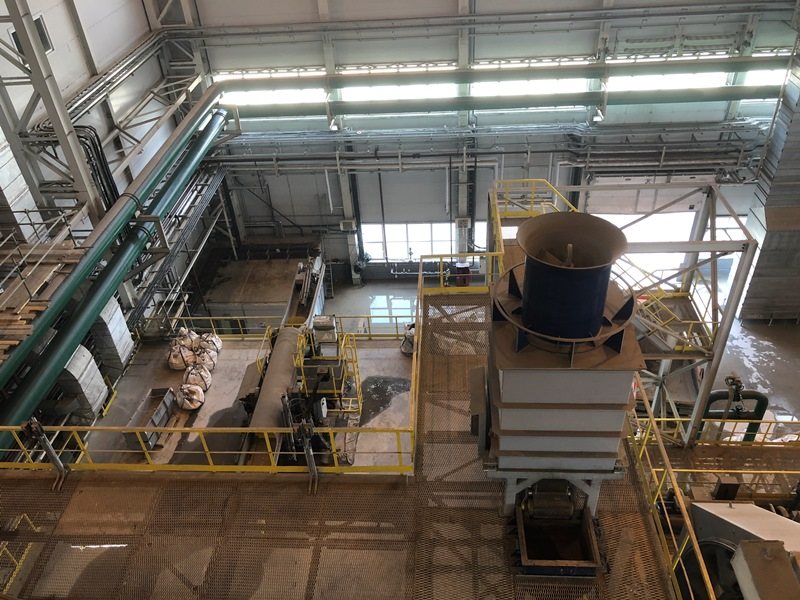
The Yanvic automatic ball charger — also called a ball feeder, ball charging system or grinding media charger — removes both problems at once. A rubber-lined storage hopper sits on four load cells; a belt feeder draws balls from it and delivers them into the mill feed chute. The controller doses by loss-in-weight — accurate to the kilogram — at exactly the rate your metallurgist sets, or the rate your plant control system calculates from mill power and fresh feed tonnage.
Same operating and control philosophy as the Metso Select™ ball feeder and FLSmidth PERI™ AutoCharge — engineered, fabricated and factory-tested in China at a fraction of OEM cost.
What we supply
- 15 t rubber-lined storage hopper mounted on four load cells
- Loss-in-weight dosing, accurate to the kilogram
- Ball sizes 40–150 mm via an adjustable discharge gate and rubber curtain
- Four control modes: Manual, Fast, Automatic and Smart
- 4–20 mA / remote I/O interface to the plant DCS and APC
- Optional VFD feed-rate control with belt speed feedback
- Media consumption logging — daily, weekly and campaign totals
- Local control cabinet with emergency stop and safety interlocks
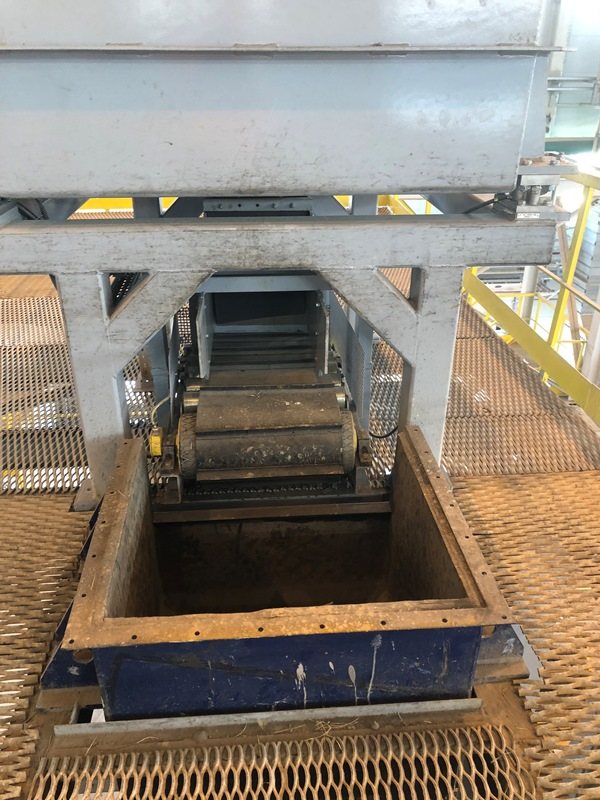
How it works: weighed hopper, belt feeder, mill chute
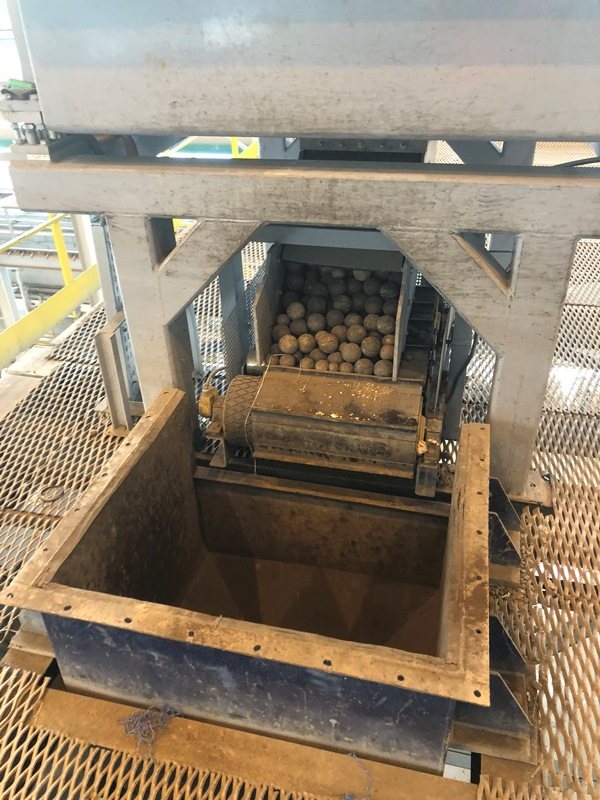
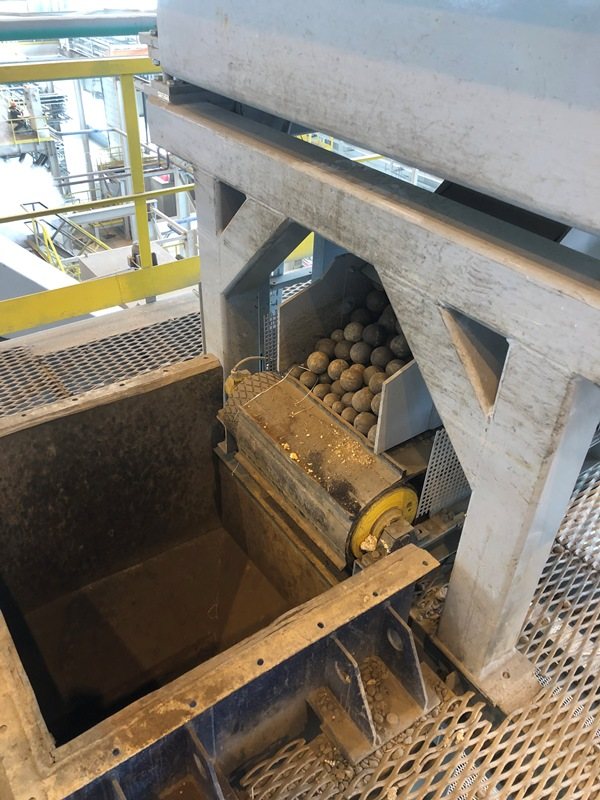
Media is loaded into the hopper by crane or forklift kibble — typically once every few days instead of every shift. On a demand signal the belt feeder starts, the adjustable gate (set to your ball diameter) and rubber curtain meter a single layer of balls onto the belt, and the balls roll down the discharge chute into the mill feed hopper together with the ore stream.
The hopper's four load cells continuously measure weight loss, so the controller knows exactly how many kilograms of media have been delivered — not an estimate from belt revolutions or running time, but a true weighed dose. Feeding stops automatically when the set weight, time interval or DCS rate is reached.
- Support stand engineered to your mill feed arrangement and floor level
- Rubber-lined 15 t hopper — quiet, wear-resistant, on four load cells
- Weighing controller with loss-in-weight measurement to the kilogram
- Heavy-duty belt feeder with motorized pulley and speed sensor
- Adjustable discharge gate matched to ball diameter, with rubber curtain
- Discharge chute into the mill feed arrangement
- Local control cabinet: remote I/O, 4–20 mA signals, DCS/APC interface
Four control modes, one target: the right ball rate
Every concentrator runs its media strategy differently. The Yanvic charger supports all of them — from simple manual feeding for commissioning to fully autonomous dosing driven by your advanced process control.
Continuous feeding started and stopped from the local panel or control room — for commissioning, charge build-up after a reline, or special campaigns.
Batch mode: the feeder runs at full rate and stops automatically when the set batch weight is reached — e.g. 500 kg after every shift.
Timed dosing: the controller adds a set weight at set time intervals, keeping the charge level constant around the clock without operator attention.
Full DCS/APC integration: the plant control system sets the ball rate from mill power draw and fresh feed tonnage, so media addition follows the ore — automatically.
- Dosing follows mill power draw and fresh feed tonnage in Smart mode
- Consumption statistics: daily, weekly and campaign media totals
- Belt speed feedback with zero-speed and run-failure alarms
- Emergency stop at the machine plus remote stop from the control room
Factory pre-assembly and testing
Every ball charger is fully pre-assembled and tested in our workshop before dispatch — hopper, load cells, belt feeder and control cabinet running together, so site installation is a matter of days, not weeks.
Standard model PBFB-15
| Parameter | Specification |
|---|---|
| Storage hopper capacity | 15 t (other capacities engineered on request) |
| Ball size range | 40–150 mm, set by adjustable discharge gate |
| Dosing accuracy | Kilogram-level, loss-in-weight via four load cells |
| Control modes | Manual / Fast / Automatic / Smart |
| Control interface | Remote I/O, 4–20 mA, DCS / APC integration |
| Feed rate adjustment | Optional VFD on the belt feeder drive |
| Monitoring | Belt speed feedback, hopper weight, consumption logging |
| Safety | Local emergency stop, remote stop, safety interlocks |
| Installation | At the mill feed chute; support stand engineered to site layout |
Hopper capacity, belt width, gate range and discharge geometry are customized to your mill size, ball size and plant layout.
Why leading plants automate ball charging
Continuous small additions hold the ball charge — and therefore mill power draw — at the design point instead of letting it decay between manual additions.
A constant charge means constant grinding environment: cyclone overflow density and P80 stay in range, shift after shift.
Plants routinely report 5–15% lower ball consumption after switching from irregular manual additions to continuous weighed dosing.
No more manual ball handling near a running mill — no kibbles, drums or shovels at the feed floor, no crew exposure to suspended loads.
One kibble lift every few days replaces per-shift ball additions; operators supervise from the control room.
Logged media consumption versus tonnes milled gives your metallurgists the g/t figure needed to optimize ball size, quality and addition rate.
Frequently asked questions
What is an automatic ball charger?+
An automatic ball charger (also called a ball feeder, ball charging system or grinding media feeder) is a machine that stores grinding balls in a weighed hopper and doses them into a SAG or ball mill automatically, at a controlled rate, without manual handling. It keeps the mill's ball charge — and therefore power draw, throughput and grind size — constant between media additions, replacing per-shift manual ball additions with continuous, kilogram-accurate dosing.
Why add balls continuously instead of in daily or per-shift batches?+
Ball charge is consumed steadily as the mill grinds. Batch additions make the charge level — and with it mill power, throughput and product fineness — swing on a daily cycle. Continuous weighed dosing holds the charge constant, which stabilizes power draw and grind size and typically reduces total media consumption by 5–15%.
Is this comparable to the Metso Select or FLSmidth PERI ball feeders?+
Yes — it follows the same proven concept: a storage hopper on load cells feeding a belt feeder with adjustable gate, dosed by loss-in-weight and integrated with the plant DCS. Yanvic chargers are engineered and fabricated in China to the same control philosophy, with full FAT before dispatch, at a significantly lower capital cost.
What ball sizes can the charger handle?+
The standard adjustable gate covers 40–150 mm balls — from SAG mill 125–150 mm media down to ball mill 40–60 mm top-up. The gate height is set to your ball diameter so only a single ball layer passes; a rubber curtain prevents double-layer carry-over.
Can it connect to our plant DCS or advanced process control?+
Yes. The control cabinet provides remote I/O and 4–20 mA signals as standard. In Smart mode the DCS or APC sets the addition rate directly from mill power draw and fresh feed tonnage; consumption totals, hopper weight and alarm states are reported back to the control system.
Tell us about your ore — we will engineer the answer.
Send us your ore samples, drawings or equipment list. Our engineers reply within 24 hours with a technical proposal and budgetary quotation.