
How to Size a Make-Up Ball Charging Strategy
Every tonne of ore that passes through a tumbling mill consumes grinding media. Steel balls wear by impact and abrasion, shrink below useful size, and leave with the discharge as scats. If make-up addition does not replace that consumption — in mass and in size — the mill's charge level, power draw and grinding environment drift, and product fineness drifts with them. Yet on many plants the make-up strategy is still 'add a drum of the usual size when the power looks low'. This article lays out the engineering alternative: how the top ball size should be calculated, how the addition rate should be set, and how automatic charging hardware closes the loop.
Start with the top size. The classical tool is Bond's formula for the maximum ball diameter: B = (F80 · K / (Cs · √D)) ^ 0.5, adjusted for work index, where B is the ball diameter in mm, F80 the feed 80%-passing size, Cs the fraction of critical speed and D the mill diameter — with the ore's Bond work index scaling the energy available per impact. The physics behind the formula is simple: a ball must be heavy enough to nip and break the coarsest particles in the feed, but every millimetre of excess diameter replaces many smaller balls that would have provided more breakage surface per tonne of charge. Oversized make-up balls are not 'safe' — they waste power, break liners faster and produce a coarser product.
Bond's formula gives a first estimate, not an answer. The correct refinement is testwork plus simulation: SMC or drop weight data for the ore's breakage characteristics, then a population-balance or JKSimMet model to compare candidate top sizes against your actual feed size distribution and target P80. In practice the calculated optimum often sits one standard ball size below what the mill was started up with — because commissioning charges are traditionally chosen conservatively, and nobody revisits the decision. We regularly find mills running 125 mm make-up balls where the ore and feed size justify 100 mm, paying for the difference in liner wear and specific energy every single day.
One size or several? For ball mills in steady operation, the industry answer is: top up with one size only — the largest size your calculation justifies. A mill at steady state develops its own equilibrium size distribution: large balls wear down into the smaller size classes, so adding only the top size continuously replenishes the whole distribution. Adding several sizes in fixed proportions only makes sense during charge build-up after a reline, or in SAG mills where two make-up sizes (typically 125/150 mm or 100/125 mm) are sometimes used to shape the load's impact-abrasion balance. If you find yourself adding three sizes 'because we always have', that is a habit, not a strategy.
Now the addition rate. The design figure is media consumption per tonne milled, expressed in g/t or g/kWh. Measure it properly: the marked ball wear test remains the reference method for wear-rate kinetics, but the practical plant number comes from inventory accounting — tonnes of balls charged over a campaign divided by tonnes milled, cross-checked against power draw and charge level trends. Typical forged-steel consumption in SAG duty runs 300–600 g/t; ball mills in wet closed circuit often run 100–300 g/t, strongly dependent on ore abrasiveness (Bond Ai), ball quality and pulp chemistry. Your make-up rate is simply consumption × throughput — 400 g/t at 300 t/h means 120 kg of balls per hour, every hour, not 2.9 t dumped once a day.
Why does the timing matter so much? Because the charge's total surface and load behaviour respond continuously. Batch additions make power draw saw-tooth: under-charged for most of the day, briefly over-charged after the addition. Continuous or quasi-continuous dosing — small weighed additions every few minutes — holds the charge within a narrow band, which stabilises cyclone feed density and flotation feed size. Plants that switch from shift-wise to continuous charging typically report not only steadier operation but 5–15% lower total media consumption, because an under-charged mill wastes impact energy on liner-on-ball contact instead of ore breakage.
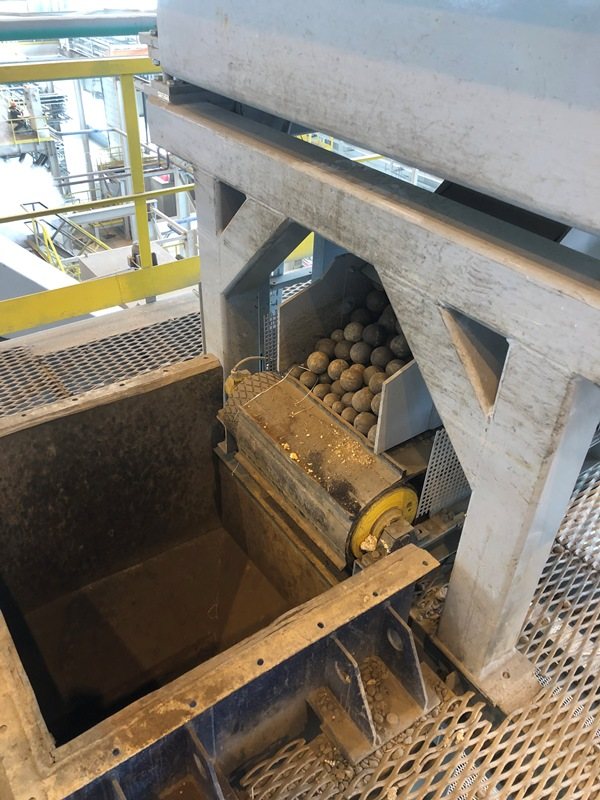
Putting it together, a defensible make-up strategy is a one-page document: the calculated top size (with the testwork reference), the design consumption in g/t (with the measurement method), the resulting hourly make-up rate in kg/h, and the control rule that adjusts it — for example, dosing rate indexed to mill power draw and fresh feed tonnage from the plant DCS. The last element is where hardware enters: this control rule is exactly what an automatic ball charger executes. A weighed-hopper charger with DCS integration, like the Yanvic PBFB-15, doses to the kilogram, logs consumption for the g/t accounting, and in Smart mode lets your APC vary the addition rate with mill power — the strategy stops being a laminated card at the feed floor and becomes a closed control loop.
Yanvic covers the full chain: SMC and Bond testwork to characterise the ore, simulation to select the make-up size, supply of the initial charge with a calculated grading, and automatic ball chargers that execute the daily strategy. Send us your mill's operating data — feed size, work index, throughput, current ball size and consumption — and we will return a sized make-up strategy with the numbers shown, plus the charger configuration that delivers it.
Have a parcel to sell, or a plant problem to solve? Talk to our team.
Get a Quote