
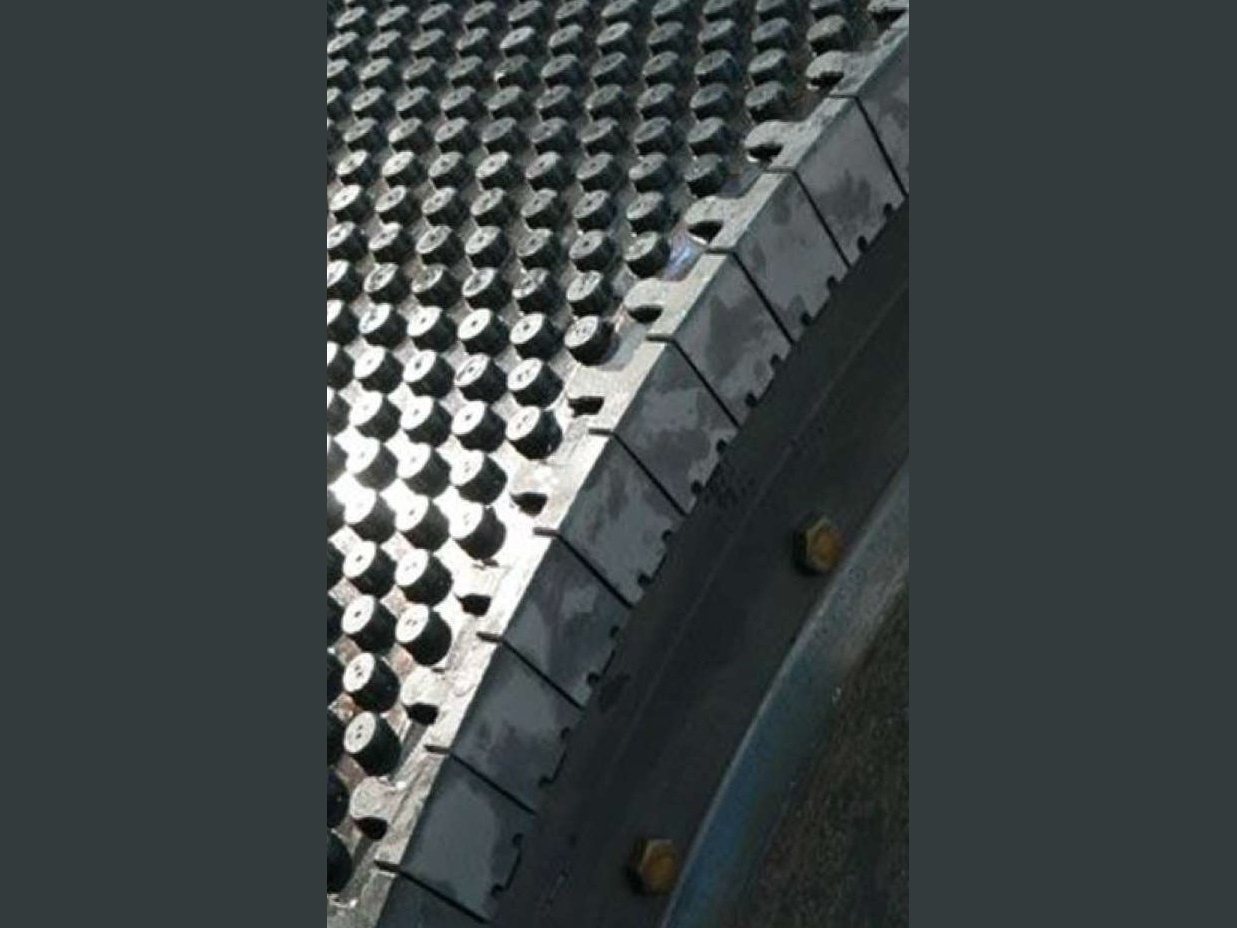
HPGR Stud Wear: When to Re-Stud vs Re-Surface
A high-pressure grinding roll protects itself: the tungsten carbide studs protruding from the roll surface trap a layer of compressed feed — the autogenous wear layer — that shields the base metal while the stud tips take the abrasion. This system works beautifully until it doesn't. Stud tips wear down, the protective layer thins, base metal between the studs starts washing out, and one day the wear report says the roll is at the end of its campaign. What happens next — re-stud, re-surface, or replace — is a six-figure decision that many plants still make by habit. It deserves better math.
Read the wear pattern before deciding anything. Uniform tip wear with an intact autogenous layer is the healthy end of a campaign: the studs did their job. Wash-out channels between studs mean the base metal was exposed — usually because stud height dropped too low, cheek plates leaked, or the feed was too dry to build a stable layer. Stud breakage and pull-out point to a different family of causes entirely: tramp metal events, sub-optimal stud grade (too hard, too brittle), poor shrink-fit or adhesive installation, or holes already damaged from a previous campaign. Edge-zone damage — the first and last rows of studs wearing or breaking early — is almost always a cheek-plate and edge-effect problem, not a stud problem.
The three end-of-life routes. Re-studding means pulling the worn studs, inspecting and reconditioning the holes, and pressing or bonding in a new stud set — the surface geometry returns to as-new, at roughly the cost of the studs plus labour. Weld re-surfacing (rebuilding the roll face with hardfacing, with or without new studs afterwards) restores diameter and profile when the base has worn or washed out, but deposits heat-affected material next to remaining studs and demands strict procedure control. Full tyre or roll replacement resets everything — at the highest capital cost and the longest lead time. Note the asymmetry: re-studding requires healthy holes and base metal; re-surfacing can rescue a damaged base but cannot rescue bad holes.
When is re-studding still on the table? Four checks answer most of it. First, hole condition: diameters, ovality and cracking around hole mouths — holes that have grown oval or cracked will not hold a new interference fit, no matter how good the new studs are. Second, remaining base thickness and diameter margin against the manufacturer's minimum. Third, crack state of the roll face between studs — deep fatigue cracking rules out a simple re-stud. Fourth, history: a tyre that has already shed studs repeatedly is telling you the holes are finished. Pass all four and re-studding is almost always the cheapest route back to a full campaign; fail two or more and you are choosing between re-surface and replacement.
Now the economics, with illustrative numbers to replace with your own. A complete carbide stud set for a large HPGR roll runs into the tens of thousands of dollars; add pulling, hole reconditioning and installation labour and a re-stud campaign typically lands at a fraction of a new studded tyre, which itself is a fraction of a new roll. Against that, the 'saving' from stretching a worn roll one more month is usually fictional: under-height studs let the autogenous layer collapse, throughput drops, specific energy rises, and edge wash-out accelerates into damage that closes off the cheap re-stud option permanently. The expensive decision is rarely re-studding too early — it is re-studding too late, when the holes are already gone.
Whatever route you choose, the next campaign is decided by what goes into the holes. Stud performance lives in the grade: WC grain size and cobalt content set the hardness-toughness balance — harder grades (HV30 up, lower Co) resist abrasion but chip under tramp impact; tougher grades absorb impact but wear faster. Head profile matters too — spherical versus conical tips age differently against your ore. And installation quality is not a detail: interference fit tolerances, bonding procedure and torque sequence decide whether a good stud survives commissioning. This is why we inspect every stud batch for chemistry, density, hardness (HRA and HV30) and dimensions before dispatch — a stud that leaves the factory wrong cannot be fixed on site.
Operations can add thousands of hours to any of these choices. Choke feeding with a stable, sufficiently moist feed builds the autogenous layer that protects everything. Tramp metal management — magnets and metal detectors that actually get maintained — removes the leading cause of stud breakage. Cheek plate condition controls the edge zones. And disciplined wear mapping at every stop, photographing the same roll quadrants campaign over campaign, turns the re-stud-or-re-surface question from an argument into a measurement.
Yanvic supplies HPGR carbide studs for rolls of every major make — CITIC Heavy Industries, Chengdu Leejun, Köppern, KHD and Metso among them — manufactured to controlled WC-Co grades with full batch inspection, plus engineering support on grade and profile selection for your ore. We also buy back spent studs at competitive prices, so the tungsten in your worn roll offsets the cost of the new set. Send us your roll drawings and last wear report, and we will return a re-stud feasibility read and a priced stud set — with the inspection certificates to match.
Have a parcel to sell, or a plant problem to solve? Talk to our team.
Get a Quote