Megaliner Relining: The Downtime Math
When a concentrator plans a SAG mill reline, the line items on the purchase order — liners, bolts, crew, craneage — are the small part of the bill. The big number never appears on an invoice: lost production. A plant treating 40,000 t/d forfeits roughly 1,650 tonnes of throughput for every hour the mill stands still. At typical copper-gold payabilities that is comfortably US$100,000–200,000 of forgone revenue per hour; on a high-throughput magnetite or porphyry operation it can be more. Against that background, relining speed is not a maintenance metric — it is a revenue lever, and it deserves the same engineering rigour as recovery or energy per tonne.
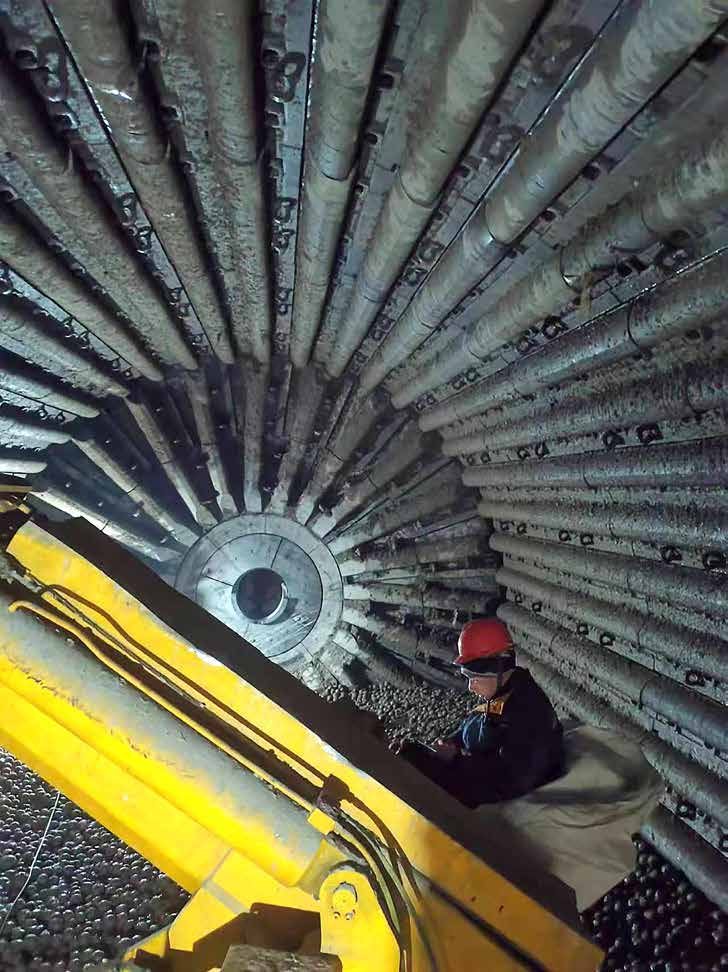
Start with the conventional baseline. A classical shell lining for a large SAG mill is built from hundreds of relatively small castings — shell plates, lifter bars, end rings — each weighing a few hundred kilograms. Every piece must be manhandled through the feed opening, positioned inside the drum by a crew working in confined space, and bolted from inside. Worn liners come out the same way: knock out hundreds of seized bolts with sledges or torches, pry pieces off the shell, pass them out through the trommel or feed chute. On a 36–40 ft SAG mill, a full shell reline typically runs 4–7 days working around the clock, with peak crews of several dozen people inside and around the mill. Every step is sequential, and almost every step happens inside the drum.
Megaliner turns that logic around. Instead of hundreds of small pieces, the shell is lined with a few dozen large modules, each integrating plate and lifter functions and weighing up to several tonnes. Nobody positions steel by hand inside the mill: a mill liner handler — a telescopic-boom, 7-axis manipulator working through the feed opening — lifts each module from a deck outside the mill, presents it to the shell, and holds it in place while the crew inserts and tensions the bolts from outside the drum. Piece count per reline drops by 60–80%, the bolt count falls in proportion, and accumulated industry experience shows shell relining time reduced by 30–50% for the same mill. Fewer pieces also means fewer joints, fewer bolt holes in the shell, and fewer opportunities for slurry racing and bolt breakage in service.
Now the arithmetic — illustrative numbers, so substitute your own. Take a Ø10.4 m SAG mill at a 90,000 t/d operation. A conventional shell reline at, say, 120 hours versus a Megaliner reline at 72 hours is a 48-hour saving. At 3,750 t/h that is 180,000 tonnes of recovered throughput per reline. Even at a conservative US$30 of margin per tonne — far below most copper or gold operations — the recovered production is worth about US$5.4 million per reline; with two shell relines a year, over US$10 million annually. Against that, the capital for a liner handler (300–7,500 kg capacity class, matched to module weight) and any premium on module engineering is recovered in the first reline. Everything after that is margin. This is why the conversation about Megaliner should start in the production office, not the warehouse.
The second ledger is safety, and it has numbers too. Conventional relining is consistently among the most hazardous routine jobs in a concentrator: confined space inside a rotating drum, suspended loads over workers, falling scale from the shell, sledgehammer and oxy-torch work at height. Megaliner removes most person-hours from inside the mill entirely — typically halving or better the in-mill exposure per reline. Bolt removal gets the same treatment: a recoilless striking hammer of the Thunder Bolt class (around 1,500 J per blow, zero recoil at the operator) knocks out a worn liner bolt in seconds, versus minutes of torch cutting or sledging per bolt — multiply that by a thousand bolts and the hours, and the exposure hours, speak for themselves.
Megaliner is not free, and honesty about the constraints is part of the engineering. Modules must pass through your mill's feed opening, so module dimensions are bounded by hardware that already exists. Module mass must sit comfortably inside the handler's capacity and reach envelope at the furthest lift — which is why liner design and handler selection cannot be two separate purchase orders. Lifting points and grapple interfaces must be cast into every module, so drawings, foundry patterns and handler tooling have to be developed together. This is precisely how Yanvic works: we size module weight to the handler class (300–7,500 kg, with radio remote control and Thunder Bolt hammers), integrate the lifting points into the casting design at CITIC Heavy Industries or Taiyuan Heavy Industry, and check the full lift sequence against your mill's geometry before metal is poured.
There are also honest cases where conventional linings still win. Small mills with feed openings too narrow for handler access, mills relined so infrequently that handler utilisation would be negligible, and duties where light rubber linings are placed quickly by hand anyway — here a classical lining remains the rational choice. The decision should be made on your numbers: mill size, feed opening, reline frequency, hourly margin, crew availability and safety targets. What is no longer defensible is choosing by habit.
Yanvic supplies both sides of the equation: manganese steel, Cr-Mo alloy, rubber and composite liners — conventional or Megaliner — cast by China's leading heavy foundries under a full ITP, plus the mill liner handlers and Thunder Bolt recoilless hammers that install them. Send us your mill drawings, current lining drawings and the report from your last reline, and we will return a piece-count, bolt-count and downtime comparison for your specific mill — with the arithmetic shown, so your production office can check every line.
Have a parcel to sell, or a plant problem to solve? Talk to our team.
Get a Quote